
DDR3 U-DIMM
JEDEC-standard DDR3 and DDR3L unbuffered memory module for platforms using a 240-pin U-DIMM architecture. Configurations are published at DDR3-1600 in 4GB and 8GB capacities.
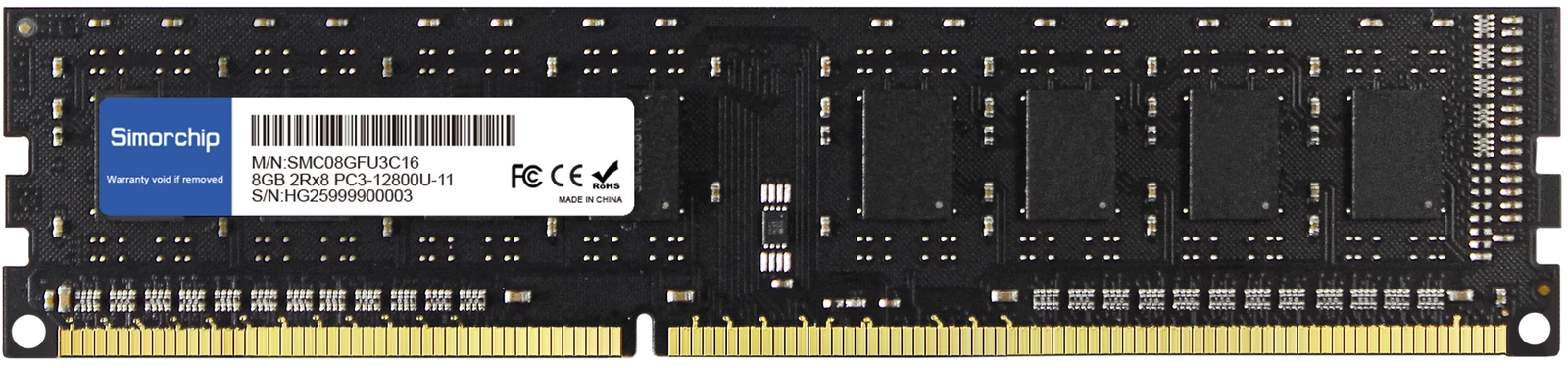
Technical Summary
Ordering Information
Configurations as published in the module datasheet. Module name is the datasheet designation; the industrial order part number is confirmed at order entry.
Industrial order part numbers
| Order P/N | Capacity | Data rate | CL | Rank | Component composition | Voltage | Datasheet |
|---|---|---|---|---|---|---|---|
| SMC04G8U3C16 | 4GB | 1600 MT/s | CL11 | 1R | 512M x 8, 8C | 1.5V | On request → |
| SMC08GFU3C16 | 8GB | 1600 MT/s | CL11 | 2R | 512M x 8, 16C | 1.5V | On request → |
| SMC08GFU3D16 | 8GB | 1600 MT/s | CL11 | 2R | 512M x 8, 16C | 1.35V | On request → |
DDR3-1600 U-DIMM, datasheet module names
| Capacity | Component composition | Module name | Rank × org. |
|---|---|---|---|
| 4GB | (512Mx8)x8C | CR1600NUN-4G | 1Rx8 |
| 8GB | (512Mx8)x16C | CR1600NUN-8G | 2Rx8 |
Order part numbers are listed with their individual specification documents; the C and D codes identify the 1.5V DDR3 and 1.35V DDR3L variants. Module names are the designations used in the family datasheet for the same configurations.
Electrical & Timing Specifications
Data rate is stated in MHz on the datasheet and shown here in MT/s, the transfer-rate unit used across this site. The numbers are unchanged.
Mechanical Specifications
Environmental Specifications & Compliance
Operating temperature and compliance are published as stated in the product datasheet. The range is specified as a DRAM case temperature (TC) in the part-number specifications.
Compatibility & Qualification
Module selection is determined by the target DIMM socket, memory controller, board layout and platform firmware. Compatibility verification is performed against the applicable target configuration according to project requirements.
Industrial Programme Controls
Configuration Control
Where configuration control is defined within the approved programme scope, qualified configurations are managed through the applicable BOM and change-review requirements.
Read more →Platform Qualification
Compatibility and stability verification are performed against the applicable target platform according to the defined qualification scope.
Read more →Lifecycle Coordination
Component availability, generation transitions and requalification requirements are reviewed against programme requirements.
Read more →Technical Change Management
Configuration changes are subject to technical review and requalification where required.
Read more →Production Verification
Production-level verification
- Incoming, in-process, final and outgoing quality control
- SPD programming and verification
- Module functional verification before shipment
Project-level qualification
- Target-platform compatibility verification
- Stability verification under the defined operating conditions
- Application-specific qualification where the programme requires it
Production-level verification applies to modules in manufacturing, where applicable to the approved production route for the product. Project-level qualification scope is defined according to project requirements and is not performed on every shipped unit.
Technical Documentation
Product Configuration Review
Provide the target platform architecture, required capacity, data rate, operating conditions and expected programme lifecycle. SIMORCHIP engineering will review the applicable module configuration and qualification requirements.